Last updated
Reviewed Jun 8, 2026Disclosure: Some links on this page are affiliate links - we may earn a commission at no extra cost to you. Commissions never change our recommendations. Read the full disclosure.
An outdoor sauna solves the two biggest problems with an indoor one: it keeps the heat and moisture out of your house, and it puts the whole ritual - hot session, cold plunge, cool-down - in the backyard where it belongs. But "best outdoor sauna" is not a brand question. It is three decisions stacked together: barrel or cabin, electric or wood-burning, and what your foundation and electrical run will actually cost. Get those right and the specific kit almost picks itself.
Below we compare the shapes and heat sources honestly, then walk through the install realities that quietly decide your budget. When you want hard numbers for your own yard, the sauna cost calculator turns your choices into an itemized cost range.
Barrel vs cabin: the shape decision
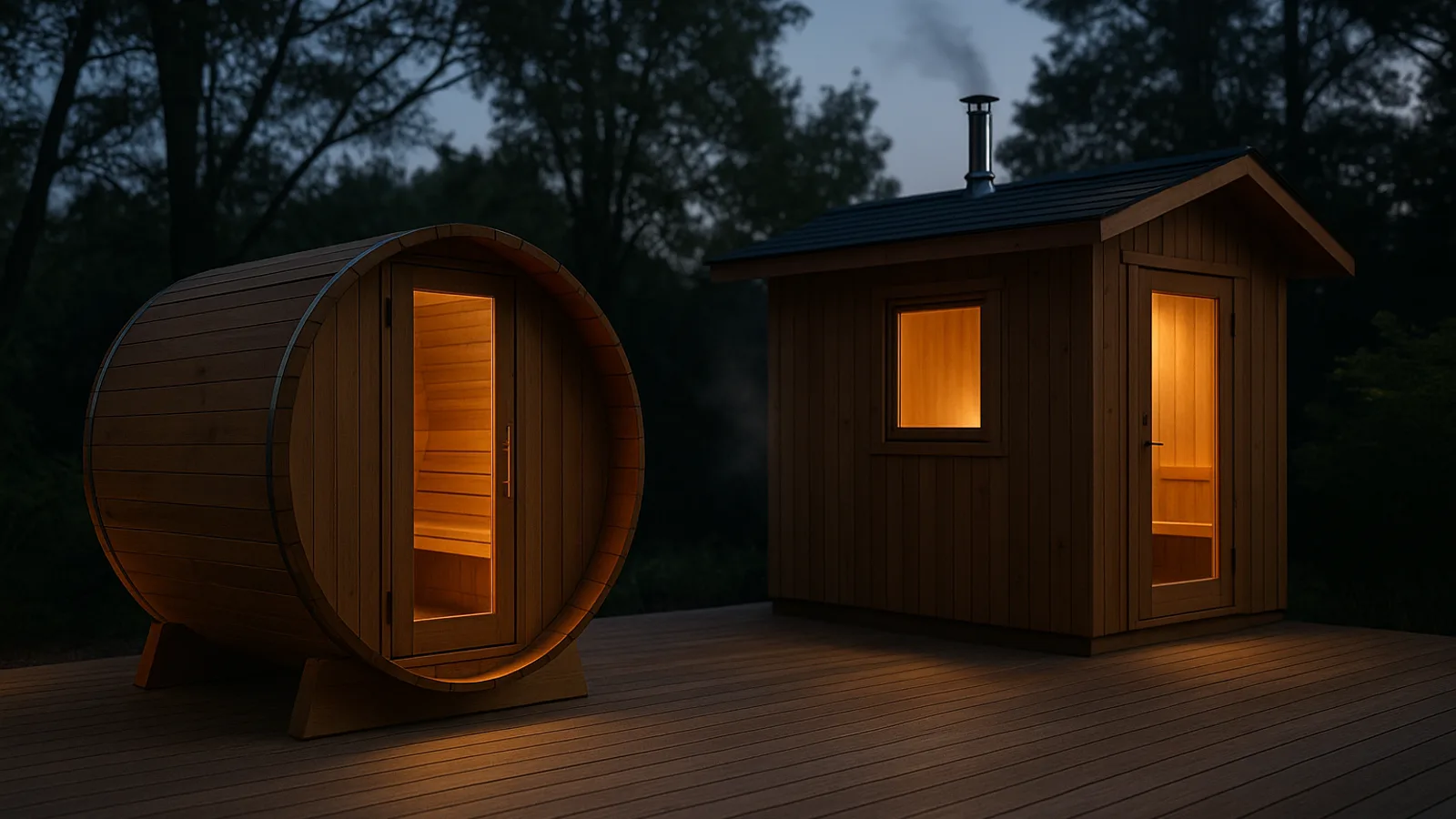
Outdoor saunas come in two main shapes, plus modern glass-fronted pods. The shape changes how fast it heats, how many people fit comfortably, and what it costs.
| Shape | Capacity | Heat-up | Layout | Typical price | Best for |
|---|---|---|---|---|---|
| Barrel (round) | 2-6 (realistic 2-4) | 40-55 min | Less air to heat; efficient | $4,000-$10,000 | Value, faster heat, classic backyard look |
| Cabin / cube | 2-8 (realistic 2-6) | 45-65 min | Full headroom, tiered benches | $5,000-$15,000 | Groups, comfort, easier to insulate |
| Pod / cube (modern) | 2-4 | 40-60 min | Large glass front, design-led | $6,000-$18,000 | Views and aesthetics; budget for glass heat loss |
Barrel (round)
- Capacity
- 2-6 (realistic 2-4)
- Heat-up
- 40-55 min
- Layout
- Less air to heat; efficient
- Typical price
- $4,000-$10,000
- Best for
- Value, faster heat, classic backyard look
Cabin / cube
- Capacity
- 2-8 (realistic 2-6)
- Heat-up
- 45-65 min
- Layout
- Full headroom, tiered benches
- Typical price
- $5,000-$15,000
- Best for
- Groups, comfort, easier to insulate
Pod / cube (modern)
- Capacity
- 2-4
- Heat-up
- 40-60 min
- Layout
- Large glass front, design-led
- Typical price
- $6,000-$18,000
- Best for
- Views and aesthetics; budget for glass heat loss
The efficiency argument for barrels is real: a round profile has less dead air above your head, so a given heater works a smaller volume and reaches temperature faster. Cabins win on headroom, tiered "sit high to feel hotter" benches, and group capacity - but they cost more and heat slower. As with indoor saunas, treat advertised person capacity as optimistic: allow about 20 inches of bench length per seated adult and knock roughly a quarter to a third off the brochure number for real comfort.
Electric vs wood-burning heat
This is the decision that shapes both your daily experience and your install. There is no wrong answer - just a trade between convenience and atmosphere.
| Heat source | Temp | Heat-up | Install needs | Maintenance | Best for |
|---|---|---|---|---|---|
| Electric (240V) | 150-195F | 40-60 min | Dedicated 240V circuit + electrician | Low (2-4 hrs/yr) | Convenience, set-and-forget daily use |
| Wood-burning | 150-195F+ | 60-90 min | Chimney, clearances, no heater circuit | Higher (15-30 hrs/yr) | Authentic loyly, off-grid, atmosphere |
Electric (240V)
- Temp
- 150-195F
- Heat-up
- 40-60 min
- Install needs
- Dedicated 240V circuit + electrician
- Maintenance
- Low (2-4 hrs/yr)
- Best for
- Convenience, set-and-forget daily use
Wood-burning
- Temp
- 150-195F+
- Heat-up
- 60-90 min
- Install needs
- Chimney, clearances, no heater circuit
- Maintenance
- Higher (15-30 hrs/yr)
- Best for
- Authentic loyly, off-grid, atmosphere
Best outdoor saunas compared (2026)
Ten outdoor saunas buyers actually cross-shop, from budget Amazon barrels to premium direct-sale cabins. We have not heat-tested these, so this is a spec-and-reputation comparison rather than a star-rated ranking - settle barrel vs cabin and electric vs wood first, then weigh wood quality, the included heater, and price. Kit prices exclude the foundation and electrical run.
| Outdoor sauna | Shape | Notable for | Approx. kit price | Where to buy |
|---|---|---|---|---|
| ALEKO Barrel | Barrel | Best value; widely available on Amazon | $3,000-5,000 | Check price → |
| Golden Designs Barrel | Barrel | Budget barrel with electric or wood options | $4,000-6,000 | Check price → |
| Almost Heaven Salem | Barrel | Popular US-made cedar barrel | $5,000-8,000 | Check price → |
| Redwood Outdoors Thermowood | Barrel | Thermowood shell that weathers well | $4,500-7,000 | Check price → |
| SaunaLife Model G | Cabin | Garden cabin with full headroom | $6,000-12,000 | Check price → |
| Dundalk LeisureCraft | Barrel / cabin | Premium Canadian cedar, many configs | $6,000-13,000 | Check price → |
| Scandia Barrel | Barrel / cabin | US-made; electric or wood | $5,000-9,000 | Check price → |
| Harvia Outdoor Cabin | Cabin | Complete cabin from a major heater maker | $6,000-12,000 | Check price → |
| Smartmak Outdoor | Cabin | Budget cube cabin with glass front | $3,500-6,000 | Check price → |
| Thermory Cabin | Cabin / pod | Premium thermowood, design-led pods | $7,000-15,000 | Check price → |
ALEKO Barrel
- Shape
- Barrel
- Notable for
- Best value; widely available on Amazon
- Approx. kit price
- $3,000-5,000
- Where to buy
- Check price →
Golden Designs Barrel
- Shape
- Barrel
- Notable for
- Budget barrel with electric or wood options
- Approx. kit price
- $4,000-6,000
- Where to buy
- Check price →
Almost Heaven Salem
- Shape
- Barrel
- Notable for
- Popular US-made cedar barrel
- Approx. kit price
- $5,000-8,000
- Where to buy
- Check price →
Redwood Outdoors Thermowood
- Shape
- Barrel
- Notable for
- Thermowood shell that weathers well
- Approx. kit price
- $4,500-7,000
- Where to buy
- Check price →
SaunaLife Model G
- Shape
- Cabin
- Notable for
- Garden cabin with full headroom
- Approx. kit price
- $6,000-12,000
- Where to buy
- Check price →
Dundalk LeisureCraft
- Shape
- Barrel / cabin
- Notable for
- Premium Canadian cedar, many configs
- Approx. kit price
- $6,000-13,000
- Where to buy
- Check price →
Scandia Barrel
- Shape
- Barrel / cabin
- Notable for
- US-made; electric or wood
- Approx. kit price
- $5,000-9,000
- Where to buy
- Check price →
Harvia Outdoor Cabin
- Shape
- Cabin
- Notable for
- Complete cabin from a major heater maker
- Approx. kit price
- $6,000-12,000
- Where to buy
- Check price →
Smartmak Outdoor
- Shape
- Cabin
- Notable for
- Budget cube cabin with glass front
- Approx. kit price
- $3,500-6,000
- Where to buy
- Check price →
Thermory Cabin
- Shape
- Cabin / pod
- Notable for
- Premium thermowood, design-led pods
- Approx. kit price
- $7,000-15,000
- Where to buy
- Check price →
Which outdoor sauna fits your yard?
Use these as format-level starting points, not star-rated winners. Where we mention brands, treat them as well-regarded examples to compare, and check the maker's spec sheet before buying.
Best for most backyards
Electric barrel sauna
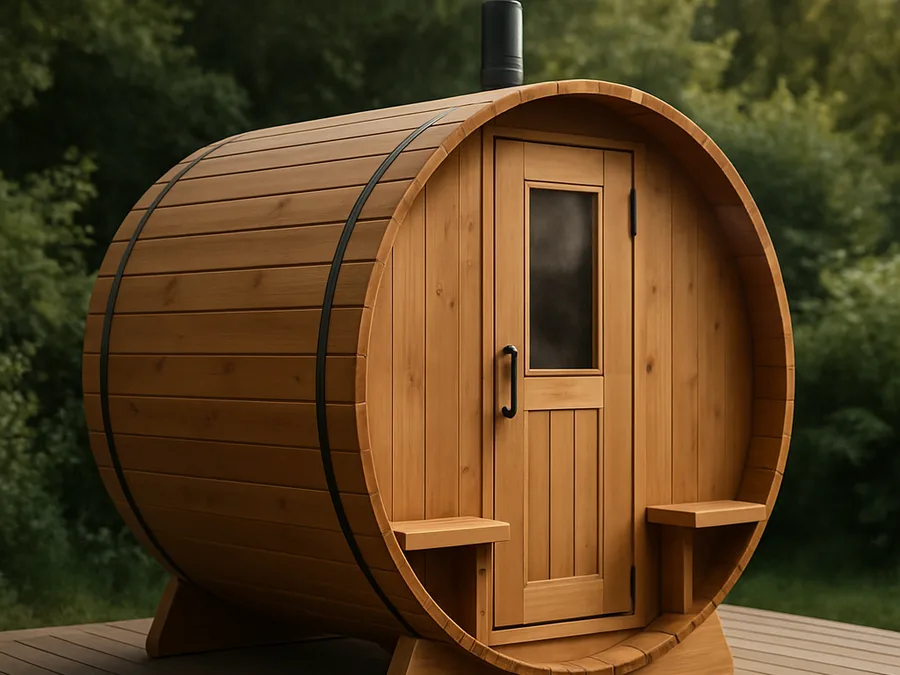
- Temp 150-195F
- Heat-up 40-55 min
- Power 240V circuit
- Install Pad + electrician
The default outdoor choice: a barrel heats faster and costs less than a cabin, and an electric heater means you flip a switch instead of tending a fire. You need a level gravel pad or pavers and a dedicated 240V circuit run to the sauna - budget for trenching if it sits away from the house.
Almost Heaven, Redwood Outdoors, and SaunaLife are common barrel makers. Thermowood or clear cedar shells weather best; pair with a Harvia or HUUM heater sized to the volume.
What works
- Fast, efficient heat for the price
- Set-and-forget electric operation
- Classic backyard look; quick to assemble
What to weigh
- 240V run can mean trenching costs
- Round walls limit bench layout
- Less headroom than a cabin
Skip if: you want off-grid heat or a large group space.
Best for atmosphere & off-grid
Wood-burning barrel or cabin
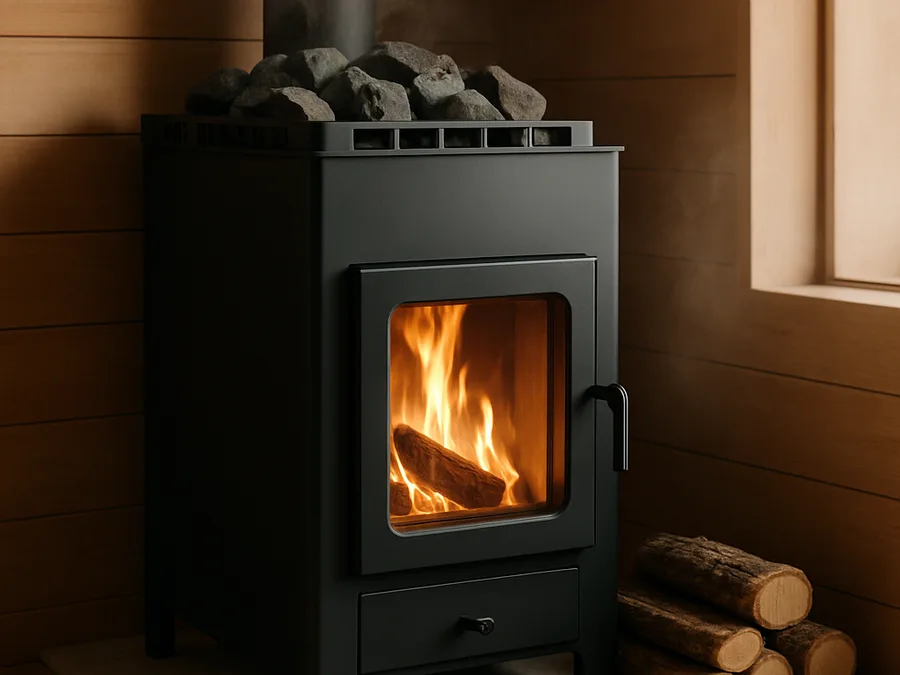
- Temp 150-195F+
- Heat-up 60-90 min
- Power No heater circuit
- Install Chimney + clearances
Wood-burning is the purist's pick: the most authentic loyly, the crackle and smell of a real fire, and no need for an electrical run - ideal for cabins, lakesides, and off-grid lots. The trade-off is a code-compliant chimney with heat shielding and clearances, a longer 60-90 minute heat-up, and real ongoing maintenance.
Harvia, HUUM, and Kuuma make well-regarded wood stoves; Almost Heaven and Dundalk LeisureCraft offer wood-ready barrels and cabins.
What works
- Most authentic, intense heat and steam
- No electrician or 240V run required
- Works off-grid
What to weigh
- Chimney, shielding, and clearances add cost
- Slowest heat-up; you tend the fire
- Most maintenance (15-30 hrs/yr)
Skip if: you want set-and-forget convenience or have strict fire/HOA rules.
Best for groups & views
Outdoor cabin or glass-front pod
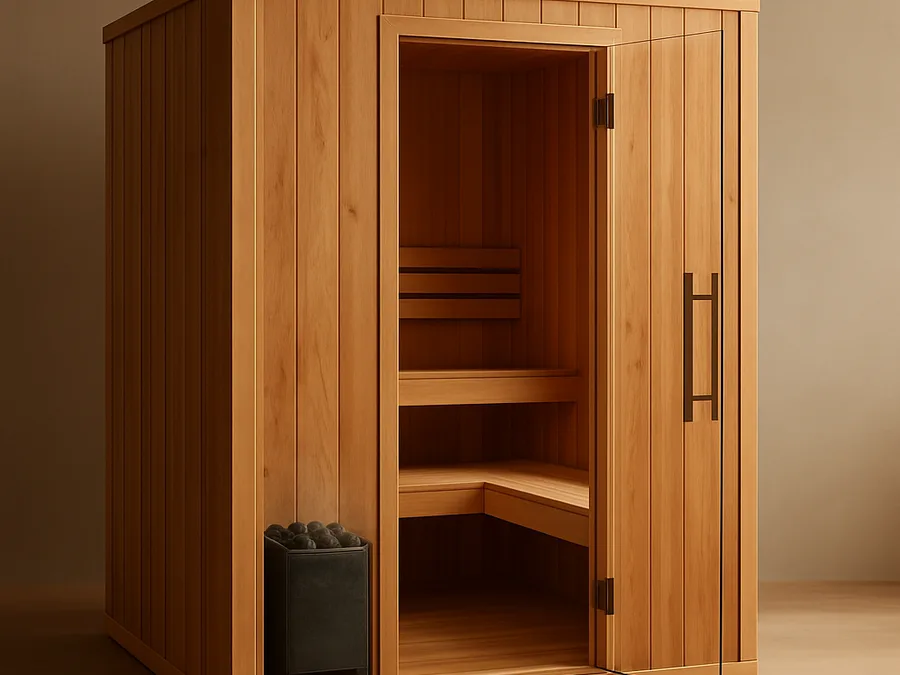
- Temp 150-195F
- Heat-up 45-65 min
- Power 240V (or wood)
- Install Slab recommended
A cube cabin gives you full headroom and tiered benches so more people can sit high where it is hottest - the better choice for families and groups. Modern glass-fronted pods trade some efficiency (glass loses heat) for a striking look and a view. Heavier cabins are happiest on a poured slab.
SaunaLife, Almost Heaven, and Dundalk LeisureCraft offer cabins and pods. Expect a larger heater (8-9 kW) and add ~6 cubic feet of effective volume per square foot of glass when sizing it.
What works
- Full headroom and tiered benches
- Best for groups and social use
- Pods offer striking design and views
What to weigh
- Heats slower; larger heater needed
- Glass fronts lose heat (size up the heater)
- Heaviest builds want a concrete slab
Skip if: you mainly sauna solo or want the lowest-cost, fastest-heating option.
Foundation, electrical & clearances
This is where outdoor budgets are won or lost. Plan it before you choose a heater.
- Foundation: a level, well-drained base is mandatory. A compacted gravel pad is cheapest and drains well; pavers on gravel are a tidy middle ground; a poured slab is most durable and best under heavy cabins. Budget roughly $300-$2,000.
- Electric heaters need a dedicated 240V circuit sized to the heater (about 6 kW on a 30A/#10 circuit, 8-9 kW on 40A/#8), installed by a licensed electrician with a GFCI breaker. Outdoor runs are often trenched in conduit, which pushes a typical run to $800-$2,500.
- A panel upgrade adds $1,500-$3,000 if your service has no spare capacity - the single biggest swing in many outdoor projects.
- Wood-burning needs a code-compliant chimney, heat shielding, and fire-rated clearances to combustibles; this install can run $1,000-$2,500 and usually needs its own permit.
- Check setbacks, permits, and HOA rules before buying. Electrical work almost always needs a permit; structures and chimneys sometimes do too.
A measured word on health benefits
Large observational studies - mostly on traditional, high-heat Finnish saunas, which is exactly what most outdoor builds are - link frequent use with lower cardiovascular and all-cause mortality, and with stress relief and recovery. These are associations, not proof of cause. Saunas are not for everyone: if you are pregnant, have heart disease, unstable blood pressure, or take medications, talk to a physician first. Hydrate, keep early sessions short, and cool down gradually. We do not make detox, weight-loss, or disease-cure claims.
The bottom line
For most backyards, an electric barrel is the best balance of cost, speed, and convenience. Want the most authentic, off-grid experience and do not mind tending a fire? Go wood-burning. Hosting groups or chasing a view? A cabin or glass-front pod earns its premium. Whichever you choose, price the foundation and the electrical run first, and estimate the full build before you buy. New to the format question entirely? Start with our best home sauna guide.
Frequently asked questions
Is a barrel or cabin sauna better for outdoors?
Electric or wood-burning for an outdoor sauna?
What foundation does an outdoor sauna need?
How much does an outdoor sauna cost installed?
Do outdoor saunas need a permit?
How far does an outdoor sauna need to be from the house or property line?
Can you leave an outdoor sauna out in winter?
Do you need to insulate an outdoor sauna?
How long does an outdoor sauna last?
How we wrote this
A synthesis guide, not a hands-on review
This guide synthesizes manufacturer specifications, independent expert reviews, building-code and electrical references, and verified owner feedback from sauna communities. We have not heat-tested every product, so we recommend by shape, heat source, and use-case rather than inventing star ratings. Where we name brands, we link to the maker's spec sheet so you can verify claims yourself. In the model comparison, the kit price is a planning range that excludes foundation and electrical, and the price links open an Amazon search for that model (an affiliate link, at no extra cost to you); several premium outdoor brands sell mainly direct, so confirm the exact configuration and what's included on the maker's own site before buying.
We have not personally tested every product mentioned. Where we describe a product we are synthesizing manufacturer specifications, independent expert reviews, building-code and electrical references, and verified owner feedback. Health information is kept conservative and sourced. Read our full methodology.
References
Sources synthesized to write this guide. Manufacturer pages cite specifications; independent publications, clinics, and code references cite real-world performance, safety, and evidence.
-
Operating temperatures and heat mechanism for traditional heat used in outdoor builds.
-
2026 price bands for barrel, cabin, and custom outdoor saunas, plus running costs.
- [3] Haven of Heat - Sauna electrical requirements (240V vs 120V, breaker & wire gauge) accessed Jun 8, 2026
Circuit, breaker, and wire-gauge sizing by heater kW for an outdoor 240V run.
-
Bench-length and volume math; why advertised barrel capacity runs optimistic.
-
Wood thermal-conductivity table and why thermowood and clear cedar weather best outdoors.
-
Clinic summary of benefits and the contraindications worth knowing before you start.
Disclosure: Some links on this page are affiliate links. Commissions never change our recommendations. Read the full disclosure.