Last updated
Reviewed Jun 8, 2026Disclosure: Some links on this page are affiliate links - we may earn a commission at no extra cost to you. Commissions never change our recommendations. Read the full disclosure.
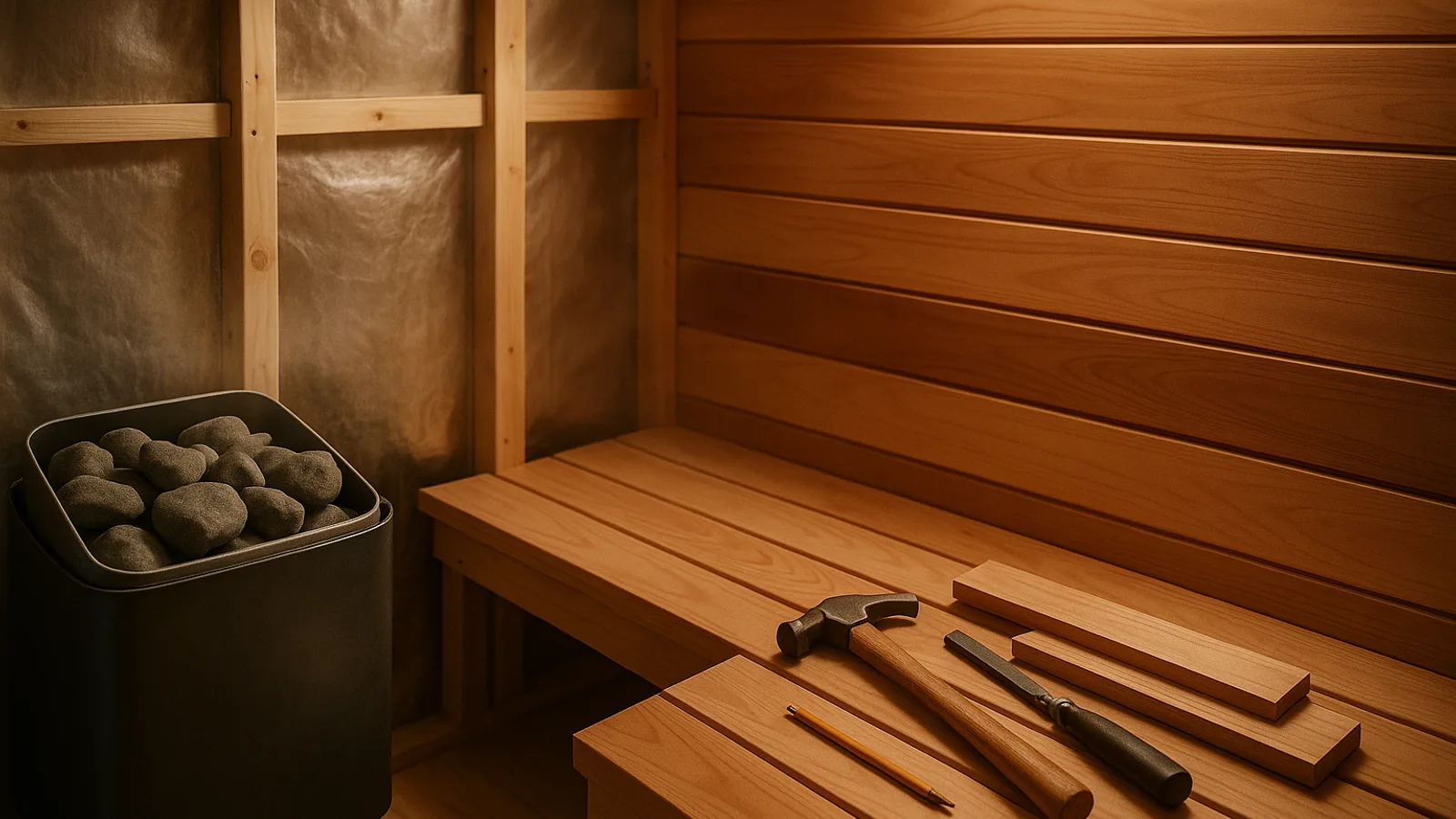
Building your own sauna is the best value per square foot - especially for larger or custom rooms - if you are comfortable with framing, insulation, a vapor barrier, and finish carpentry. The decision is not which kit "wins": it is kit vs scratch build, the right heater kW for your room's volume, and the 240V circuit that heater demands. Get those three right and the rest is execution.
Below we walk the build step by step, give you heater-sizing and circuit tables you can plan against, shortlist the heaters worth considering, and cover the woods and details beginners get wrong. For a full itemized budget, run the sauna cost calculator.
Build a sauna step by step
Every build comes down to the same ordered decisions. Expand each step for the detail - the order matters, because your size choice drives the heater, and the heater drives the electrical.
1 Decide the size and who it's for
2 Choose location and heat source
3 Size the heater (kW) to the room
4 Frame, insulate, vapor barrier, and ventilate
5 Clad the room and build the benches
6 Install the heater and electrical
7 Door, controls, and first burn-in
Kit vs scratch build vs room conversion
There are three realistic DIY paths. Most people are best served by a pre-cut kit plus a separately chosen quality heater.
| Approach | Skill needed | Time | Typical cost | Best for |
|---|---|---|---|---|
| Pre-cut kit | Intermediate | 1-3 days | $3,000-$9,000 + heater | Most DIYers; balance of cost, speed, quality |
| Scratch build | Advanced | 40-100+ hrs | $2,000-$6,000 materials + heater | Custom rooms, best value/sq ft, experienced builders |
| Convert a room | Intermediate-Advanced | Varies | $2,500-$7,000 + heater | Using an existing closet, basement, or bathroom shell |
Pre-cut kit
- Skill needed
- Intermediate
- Time
- 1-3 days
- Typical cost
- $3,000-$9,000 + heater
- Best for
- Most DIYers; balance of cost, speed, quality
Scratch build
- Skill needed
- Advanced
- Time
- 40-100+ hrs
- Typical cost
- $2,000-$6,000 materials + heater
- Best for
- Custom rooms, best value/sq ft, experienced builders
Convert a room
- Skill needed
- Intermediate-Advanced
- Time
- Varies
- Typical cost
- $2,500-$7,000 + heater
- Best for
- Using an existing closet, basement, or bathroom shell
How to size a sauna heater (by volume)
Size by cubic feet, not by the brochure's "person" count. The rule of thumb is roughly 1 kW of heater per 45-50 cubic feet of a well-insulated room (volume = length x width x height). Add 15-25% for lots of glass, poor insulation, or a cold location, and about 6 cubic feet of effective volume per square foot of glass. Then confirm against the specific heater's chart.
| Interior | Floor | Volume | Heater | Heat-up | Realistic capacity |
|---|---|---|---|---|---|
| 4x6 ft | 24 sq ft | ~168 cu ft | 4.5-6 kW | 25-35 min | 1-2 |
| 5x7 ft | 35 sq ft | ~245 cu ft | 6-8 kW | 30-45 min | 2-3 |
| 6x8 ft | 48 sq ft | ~336 cu ft | 8-9 kW | 40-55 min | 3-4 |
| 7x9 ft | 63 sq ft | ~441 cu ft | 9-12 kW | 45-65 min | 4-6 |
4x6 ft
- Floor
- 24 sq ft
- Volume
- ~168 cu ft
- Heater
- 4.5-6 kW
- Heat-up
- 25-35 min
- Realistic capacity
- 1-2
5x7 ft
- Floor
- 35 sq ft
- Volume
- ~245 cu ft
- Heater
- 6-8 kW
- Heat-up
- 30-45 min
- Realistic capacity
- 2-3
6x8 ft
- Floor
- 48 sq ft
- Volume
- ~336 cu ft
- Heater
- 8-9 kW
- Heat-up
- 40-55 min
- Realistic capacity
- 3-4
7x9 ft
- Floor
- 63 sq ft
- Volume
- ~441 cu ft
- Heater
- 9-12 kW
- Heat-up
- 45-65 min
- Realistic capacity
- 4-6
Note the realistic capacity column: advertised person capacity runs about a quarter to a third optimistic. Allow ~20 inches of bench length per seated adult, and about 70 inches if anyone wants to lie flat. Tiered benches let you sit higher where it is hotter.
The 240V circuit and wire gauge
This is the part you do not improvise. Traditional electric heaters above ~3 kW need a dedicated 240V circuit on a GFCI breaker, installed by a licensed electrician. Use this as a planning reference, then confirm exact sizing with the heater's manual and your electrician (wire gauge also depends on run length).
| Heater power | Voltage | Breaker | Wire (copper) | Typical use |
|---|---|---|---|---|
| Up to 1.5 kW | 120V | 15-20A | #12 | Some plug-in / small infrared |
| 4.5 kW | 240V | 20A | #12 | Small 1-2 person room |
| 6 kW | 240V | 30A | #10 | Most popular home size |
| 8 kW | 240V | 40A | #8 | 5x7 to 6x8 ft rooms |
| 9-10.5 kW | 240V | 50A | #6 | Large or glass-heavy rooms |
Up to 1.5 kW
- Voltage
- 120V
- Breaker
- 15-20A
- Wire (copper)
- #12
- Typical use
- Some plug-in / small infrared
4.5 kW
- Voltage
- 240V
- Breaker
- 20A
- Wire (copper)
- #12
- Typical use
- Small 1-2 person room
6 kW
- Voltage
- 240V
- Breaker
- 30A
- Wire (copper)
- #10
- Typical use
- Most popular home size
8 kW
- Voltage
- 240V
- Breaker
- 40A
- Wire (copper)
- #8
- Typical use
- 5x7 to 6x8 ft rooms
9-10.5 kW
- Voltage
- 240V
- Breaker
- 50A
- Wire (copper)
- #6
- Typical use
- Large or glass-heavy rooms
Wood & materials that matter
Wood choice is about safety and longevity, not just looks. The key rule: bench wood must stay cool to the touch.
- Benches: aspen or abachi (lowest thermal conductivity - won't burn bare skin).
- Walls & ceiling: Western red cedar (aromatic, rot-resistant, 20-30 yr) or budget Nordic spruce.
- Outdoor / premium: thermally modified spruce ("thermowood") for stability and weathering.
- Never: resinous or knotty pine on bench surfaces - resin liquefies at sauna heat and burns.
- Behind the wood: a foil vapor barrier plus insulation, and proper intake/exhaust ventilation - non-negotiable for a traditional sauna.
A curated sauna heater shortlist
The heater is the single most important component in a traditional build. Rather than list dozens, here are eight well-regarded options worth comparing, grouped by electric, wood-burning, and infrared. These are starting points, not star-rated winners - size the kW to your room's volume and confirm against the manufacturer's chart before buying.
Harvia electric (KIP, Cilindro, Vega)
Best all-round value
Finland's largest sauna brand makes dependable, widely available electric heaters across the whole size range - from simple wall-mounted units to large stone-capacity towers. A safe default for most home builds.
What works
- Huge model range and availability
- Good stone mass on larger units
- Easy to source parts
What to weigh
- Entry models have basic controls
- Match the kW to your room volume
HUUM DROP / HIVE
Best design and soft heat
Estonian heaters known for a clean, minimalist look and generous stone capacity - the HIVE buries the element in rocks for soft, even loyly. Often paired with the UKU Wi-Fi controller.
What works
- Striking minimalist design
- Large stone mass = softer steam
- App / remote control option
What to weigh
- Premium price
- Controller often sold separately
EOS (German-engineered)
Best premium controls
German manufacturer with a strong reputation for build quality and sophisticated control systems, including combi (steam) units. A good fit if you want precise, feature-rich operation.
What works
- Excellent build quality
- Advanced and combi options
- Precise control systems
What to weigh
- Higher cost
- Some models need a separate controller
Finlandia / Finnleo (FLB)
Best mid-range reliability
Long-established in the North American market with straightforward, reliable electric heaters and strong dealer support - an easy, no-drama choice for a standard home room.
What works
- Proven, reliable units
- Good North American support
- Simple to specify
What to weigh
- Less design-forward
- Mid-to-premium pricing
Scandia electric
Best budget electric
A value-oriented North American option that covers small to mid rooms at a lower price point. A sensible pick when the budget is tight and you do not need premium controls or stone mass.
What works
- Lower upfront cost
- Covers small-to-mid rooms
- Simple operation
What to weigh
- Smaller stone capacity
- Fewer premium features
Harvia wood-burning (M-series, Pro)
Best value wood stove
Widely available wood-burning stoves for cabins and outdoor builds, in models rated by room size. Gives authentic loyly and off-grid capability - but you must add a code-compliant chimney, heat shielding, and clearances.
What works
- Authentic, intense loyly
- Off-grid, no heater circuit
- Range of room sizes
What to weigh
- Needs chimney + clearances
- More maintenance than electric
Kuuma by Lamppa (USA)
Best high-efficiency wood
American-made wood stoves with a reputation for high efficiency and long burn times among off-grid and cabin builders. A premium choice where firewood and authenticity are the point.
What works
- Very efficient, long burns
- Robust, made in the USA
- Loved by off-grid builders
What to weigh
- Premium price
- Still needs chimney + clearances
Carbon / ceramic infrared panels
Best for an infrared room
If you are building an infrared room rather than a traditional sauna, you buy panels (not a stone heater) sized by occupancy. Look for low-EMF designs with third-party testing measured where the body sits.
What works
- Plug-in, no 240V circuit
- Low running cost
- Easy retrofit into a room
What to weigh
- No steam / loyly
- Verify low-EMF test data
Where to source kits, heaters & materials
Format-level starting points, not star-rated winners. Where we mention brands, treat them as well-regarded examples to compare, and check spec sheets before buying.
Best for most DIY builders
Pre-cut indoor sauna kit
- Skill Intermediate
- Build time 1-3 days
- Heater Sized to room kW
- Electrical 240V + electrician
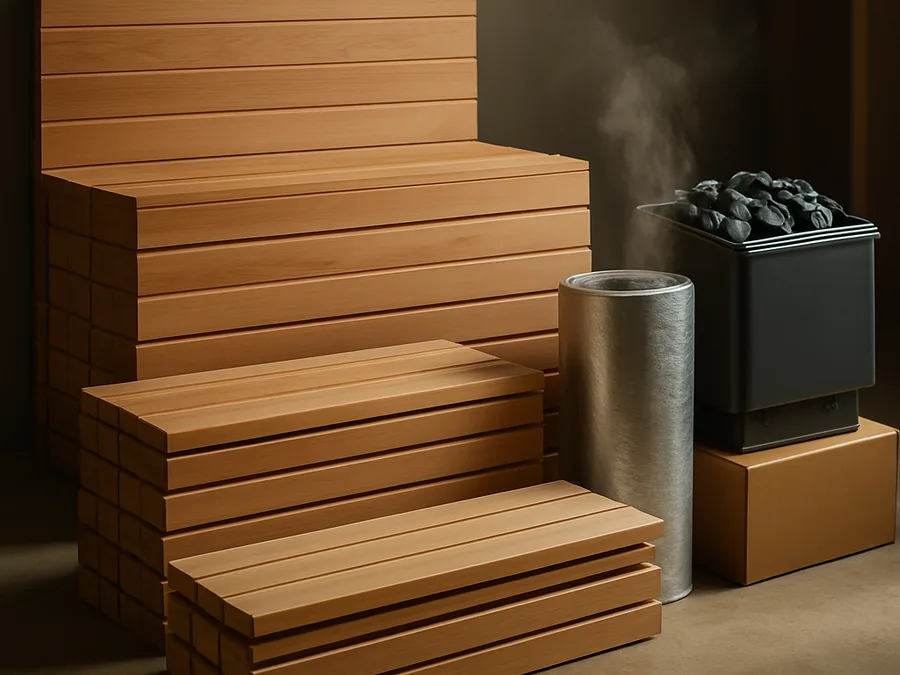
A pre-cut kit is the sweet spot for most people: pre-measured wall and bench components, vapor barrier, and a matched heater spec, assembled in a day or two. You skip the hardest cutting and fitting and still get to choose a quality heater.
Superior Saunas, SaunaPlace, and Finnleo offer pre-cut kits; Almost Heaven and SaunaLife are common in the indoor space. Confirm the kit's heater kW matches your room volume.
What works
- Removes the most error-prone work
- Fast assembly; predictable result
- Choose your own quality heater
What to weigh
- Costs more than scratch materials
- Less customizable than a scratch build
- Still needs an electrician for 240V
Skip if: you want a fully custom room or the lowest possible material cost.
Best single decision in the build
Traditional sauna heater (electric)
- Power 4.5-9 kW typical
- Voltage 240V dedicated
- Sizing ~1 kW / 45-50 cu ft
- Breaker 20-50A + GFCI
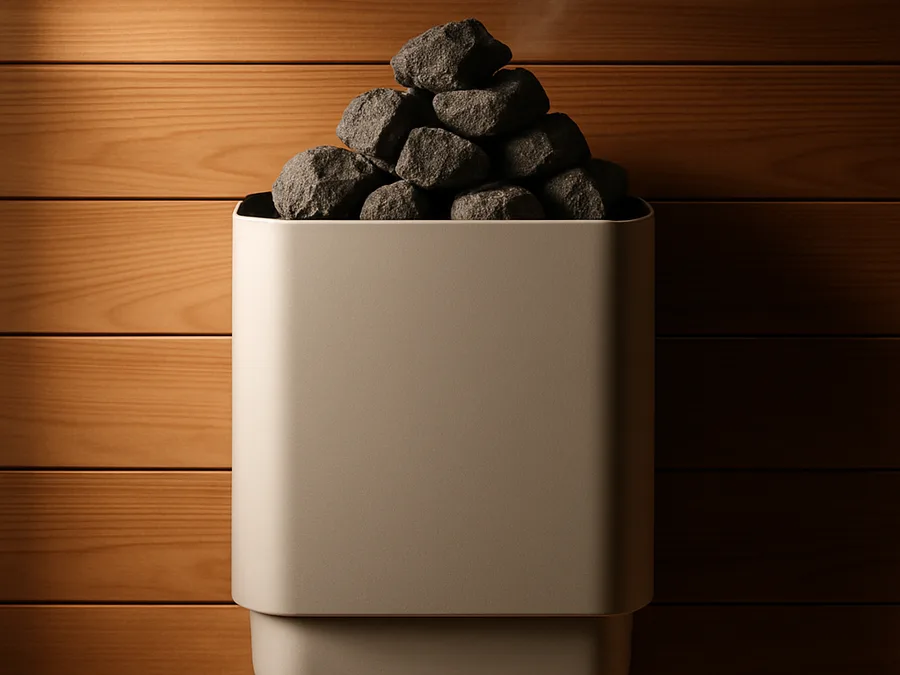
The heater is the heart of a traditional sauna - size it to your room's volume, not its 'person' rating. A good heater holds enough stone mass for proper loyly (steam when you pour water) and even heat.
Harvia, HUUM, Finlandia, and EOS are well-regarded heater brands; for wood-burning, look at Harvia, HUUM, and Kuuma. Match the kW to the sizing table above and verify the manufacturer's chart.
What works
- Right kW = fast, even, reliable heat
- Stone mass enables proper loyly
- Quality units last 10-20+ years
What to weigh
- Needs a dedicated 240V GFCI circuit
- Undersizing leaves the room never hot enough
- Oversizing wastes energy and trips breakers
Skip if: you are building an infrared room (uses panels, not a stone heater).
Best for scratch builders & upgrades
Sauna wood & materials
- Benches Aspen / abachi
- Walls Cedar / spruce
- Barrier Foil vapor barrier
- Extras Door, vents, guard
Scratch builders assemble their own material list: tongue-and-groove cladding, bench lumber, a foil vapor barrier, insulation, a sauna door, vents, and a heater guard. This is the lowest-cost, most customizable path - and the most demanding.
Superior Saunas and SaunaPlace sell lumber and components by the piece. Budget roughly $660-$1,100 in wood for a 5x7 room in Nordic spruce, more for cedar or thermowood.
What works
- Lowest material cost; fully custom
- Choose every wood and fitting
- Ideal for odd-shaped rooms
What to weigh
- Advanced carpentry and 40-100+ hours
- You own the vapor-barrier/venting details
- Mistakes are costly to redo
Skip if: you are not confident with framing, insulation, and a vapor barrier.
The bottom line
For most builders, a pre-cut kit plus a quality heater sized to your room's volume is the best balance of cost, speed, and result. Scratch-build with a materials pack only if you are confident with the vapor barrier and ventilation. Whichever path you take, size the heater by cubic feet, get a licensed electrician for the 240V circuit, and estimate the full build first. Still deciding on a format? Start with the best home sauna guide or compare outdoor builds.
Frequently asked questions
What size sauna heater do I need?
What electrical circuit does a sauna heater need?
Is it cheaper to build a sauna or buy a kit?
What wood should I use to build a sauna?
Do I need a vapor barrier and ventilation?
How long does it take to build a sauna from a kit?
Can you build a sauna in a basement or garage?
Do you need a permit to build a sauna?
Can a beginner build a sauna kit?
How we wrote this
A synthesis guide, not a hands-on review
This guide synthesizes manufacturer specifications, sauna-builder references, and electrical and building-code guidance. Heater-sizing and circuit figures are general planning rules of thumb, not a substitute for the heater manufacturer's manual or a licensed electrician. We have not built every kit, so we recommend by approach and use-case rather than inventing star ratings.
We have not personally tested every product mentioned. Where we describe a product we are synthesizing manufacturer specifications, independent expert reviews, building-code and electrical references, and verified owner feedback. Health information is kept conservative and sourced. Read our full methodology.
References
Sources synthesized to write this guide. Manufacturer pages cite specifications; independent publications, clinics, and code references cite real-world performance, safety, and evidence.
-
Wood thermal-conductivity table, why bench wood differs from wall wood, and build-from-scratch material lists.
-
Volume math (L x W x H) and the ~1 kW per 45-50 cu ft heater-sizing rule used below.
- [3] Haven of Heat - Sauna electrical requirements (240V vs 120V, breaker & wire gauge) accessed Jun 8, 2026
Breaker and wire-gauge sizing by heater kW; GFCI and dedicated-circuit requirements.
-
Bench-length and headroom guidance; tiered-bench layout for heat stratification.
-
2026 material, heater, and kit price bands for DIY budgeting.
-
Heat mechanism and temperature targets for traditional electric and wood heaters.
Disclosure: Some links on this page are affiliate links. Commissions never change our recommendations. Read the full disclosure.