Last updated
Reviewed Jun 10, 2026Disclosure: Some links on this page are affiliate links - we may earn a commission at no extra cost to you. Commissions never change our recommendations. Read the full disclosure.
The heater is what turns a wooden box into a sauna. Get it right and everything else - heat, steam, comfort, running cost - falls into place. Get it wrong and you have a room that never quite reaches temperature, or a tripping breaker and a frustrated electrician. "Best sauna heater" is not really a brand question. It is three decisions stacked together: electric or wood, the right kW for your room's volume, and the circuit and wiring that heater demands.
Below we walk through each one honestly, then suggest heaters by use-case rather than ranking gear we have not tested. When you want hard numbers for the whole project, the sauna cost calculator turns your choices into an itemized range.
Electric vs wood-burning vs infrared
Three heat sources power home saunas, and they are not interchangeable. Electric rock heaters are the default for indoor traditional saunas; wood stoves suit outdoor and off-grid builds; and infrared "heaters" are really radiant panels for a different, cooler kind of cabin.
| Heater type | Temp | Heat-up | Install needs | Maintenance | Best for |
|---|---|---|---|---|---|
| Electric (rock heater) | 150-195F | 30-45 min | Dedicated 240V circuit + electrician | Low (2-4 hrs/yr) | Indoor, convenient daily use |
| Wood-burning | 150-195F+ | 60-90 min | Chimney, shielding, clearances; no heater circuit | Higher (15-30 hrs/yr) | Outdoor, off-grid, authentic loyly |
| Infrared panels | 110-150F | 10-20 min | Plugs into 120V outlet | Very low | Renters, daily radiant heat (not a rock sauna) |
Electric (rock heater)
- Temp
- 150-195F
- Heat-up
- 30-45 min
- Install needs
- Dedicated 240V circuit + electrician
- Maintenance
- Low (2-4 hrs/yr)
- Best for
- Indoor, convenient daily use
Wood-burning
- Temp
- 150-195F+
- Heat-up
- 60-90 min
- Install needs
- Chimney, shielding, clearances; no heater circuit
- Maintenance
- Higher (15-30 hrs/yr)
- Best for
- Outdoor, off-grid, authentic loyly
Infrared panels
- Temp
- 110-150F
- Heat-up
- 10-20 min
- Install needs
- Plugs into 120V outlet
- Maintenance
- Very low
- Best for
- Renters, daily radiant heat (not a rock sauna)
How to size a sauna heater (kW by room volume)
This is the single most important number, and the one most people get wrong by trusting the advertised "seats 4" rating. Size to volume, not people. Multiply your room's length x width x height in feet to get cubic feet, then allow roughly 1 kW per 45-50 cubic feet. Then adjust up for anything that bleeds heat.
| Interior (7 ft ceiling) | Realistic capacity | Heater kW | Circuit / wire | Heat-up |
|---|---|---|---|---|
| 4x6 ft (~168 cu ft) | 1-2 | 4.5-6 kW | 30A / #10 | 25-35 min |
| 5x7 ft (~245 cu ft) | 2-3 | 6-8 kW | 30-40A / #10-#8 | 30-45 min |
| 6x8 ft (~336 cu ft) | 3-4 | 8-9 kW | 40A / #8 | 40-55 min |
| 7x9 ft (~441 cu ft) | 4-6 | 9-12 kW | 50-60A / #6 | 45-65 min |
4x6 ft (~168 cu ft)
- Realistic capacity
- 1-2
- Heater kW
- 4.5-6 kW
- Circuit / wire
- 30A / #10
- Heat-up
- 25-35 min
5x7 ft (~245 cu ft)
- Realistic capacity
- 2-3
- Heater kW
- 6-8 kW
- Circuit / wire
- 30-40A / #10-#8
- Heat-up
- 30-45 min
6x8 ft (~336 cu ft)
- Realistic capacity
- 3-4
- Heater kW
- 8-9 kW
- Circuit / wire
- 40A / #8
- Heat-up
- 40-55 min
7x9 ft (~441 cu ft)
- Realistic capacity
- 4-6
- Heater kW
- 9-12 kW
- Circuit / wire
- 50-60A / #6
- Heat-up
- 45-65 min
Best electric sauna heaters compared (2026)
Once you have sized the kW to your room above, the brand decision comes down to controls, stone capacity, and build quality. These are ten well-regarded electric rock heaters that cover the range from budget to premium. We have not bench-tested each one, so this is a spec-and-reputation comparison rather than a star-rated ranking - match the output to your room first, then pick the model whose controls and price suit you.
| Heater | Output | Notable for | Approx. price | Where to buy |
|---|---|---|---|---|
| Harvia KIP | 4.5-8 kW | Best value; simple built-in dial controls | $400-700 | Check price → |
| Harvia Cilindro | 6-10.5 kW | Tall cylindrical body holds extra stone for soft, long-lasting loyly | $900-1,500 | Check price → |
| Harvia Virta Combi | 6.8-9 kW | Built-in steam generator for a humid loyly without a separate steamer | $1,200-1,900 | Check price → |
| Harvia The Wall | 6-9 kW | Slim glass-front design pick for a modern cabin | $1,300-2,100 | Check price → |
| HUUM DROP | 4.5-9 kW | Minimalist teardrop design; separate UKU controller | $900-1,300 | Check price → |
| HUUM HIVE | 6-18 kW | Very large stone capacity for big or commercial rooms | $1,300-2,400 | Check price → |
| Finlandia FLB | 4.5-10.5 kW | Wide size range; long-running US-market staple | $700-1,200 | Check price → |
| Scandia Electric | 3-9 kW | Budget-friendly; smallest 3 kW runs on some 240V circuits | $500-950 | Check price → |
| Tylo Sense | 6-10.7 kW | Premium build with integrated digital control and app options | $1,200-2,300 | Check price → |
| Amerec Designer | 4.5-9 kW | Commercial-grade stainless build with separate controller | $700-1,400 | Check price → |
Harvia KIP
- Output
- 4.5-8 kW
- Notable for
- Best value; simple built-in dial controls
- Approx. price
- $400-700
- Where to buy
- Check price →
Harvia Cilindro
- Output
- 6-10.5 kW
- Notable for
- Tall cylindrical body holds extra stone for soft, long-lasting loyly
- Approx. price
- $900-1,500
- Where to buy
- Check price →
Harvia Virta Combi
- Output
- 6.8-9 kW
- Notable for
- Built-in steam generator for a humid loyly without a separate steamer
- Approx. price
- $1,200-1,900
- Where to buy
- Check price →
Harvia The Wall
- Output
- 6-9 kW
- Notable for
- Slim glass-front design pick for a modern cabin
- Approx. price
- $1,300-2,100
- Where to buy
- Check price →
HUUM DROP
- Output
- 4.5-9 kW
- Notable for
- Minimalist teardrop design; separate UKU controller
- Approx. price
- $900-1,300
- Where to buy
- Check price →
HUUM HIVE
- Output
- 6-18 kW
- Notable for
- Very large stone capacity for big or commercial rooms
- Approx. price
- $1,300-2,400
- Where to buy
- Check price →
Finlandia FLB
- Output
- 4.5-10.5 kW
- Notable for
- Wide size range; long-running US-market staple
- Approx. price
- $700-1,200
- Where to buy
- Check price →
Scandia Electric
- Output
- 3-9 kW
- Notable for
- Budget-friendly; smallest 3 kW runs on some 240V circuits
- Approx. price
- $500-950
- Where to buy
- Check price →
Tylo Sense
- Output
- 6-10.7 kW
- Notable for
- Premium build with integrated digital control and app options
- Approx. price
- $1,200-2,300
- Where to buy
- Check price →
Amerec Designer
- Output
- 4.5-9 kW
- Notable for
- Commercial-grade stainless build with separate controller
- Approx. price
- $700-1,400
- Where to buy
- Check price →
Which sauna heater fits your build?
Use these as type-and-size starting points, not star-rated winners. Where we name brands, treat them as well-regarded examples to compare, and check the maker's spec sheet and manual before you buy and wire anything.
Best for most indoor home saunas
6 kW electric rock heater
- Output 6 kW
- Circuit 30A / #10
- Room ~150-300 cu ft
- Stones ~40-60 lbs
The workhorse size for a typical indoor home sauna. A 6 kW heater heats a 4x6 to 5x7 ft room to a proper 175-195F in 30-45 minutes on a dedicated 30A/240V circuit with #10 wire and a GFCI breaker.
Harvia, HUUM, and Finlandia all make well-regarded 6 kW wall-mounted heaters; pick one with a stone capacity and control type (built-in dial vs separate digital controller) that suits your room.
What works
- Right size for the most common home saunas
- Fast, controllable heat with low maintenance
- Wide model choice across trusted brands
What to weigh
- Needs a dedicated 240V circuit + electrician
- Undersize it and the room never gets hot
- Stones need re-stacking about once a year
Skip if: your room is larger than ~300 cu ft or has a big glass front - size up to 8-9 kW.
Best for larger or glass-fronted rooms
8-9 kW electric rock heater
- Output 8-9 kW
- Circuit 40A / #8
- Room ~300-400 cu ft
- Stones ~60-100 lbs
Step up to 8-9 kW for a 6x8 ft room, a glass-fronted cabin, or a cooler space like a garage. It needs a 40A/240V circuit with #8 wire, so confirm your panel has the spare capacity before buying.
Harvia and HUUM both offer 8-9 kW heaters with larger stone chambers; more stone mass means a softer, longer-lasting loyly when you throw water.
What works
- Holds temperature in larger or leaky rooms
- More stone mass = better, softer steam
- Headroom for glass fronts and cold climates
What to weigh
- Needs a 40A circuit; may force a panel upgrade
- Overkill (and wasteful) in a small 4x6 room
- Higher running cost than a 6 kW unit
Skip if: your room is under ~250 cu ft - a 6 kW heater is the more efficient match.
Best for outdoor & off-grid
Wood-burning sauna stove
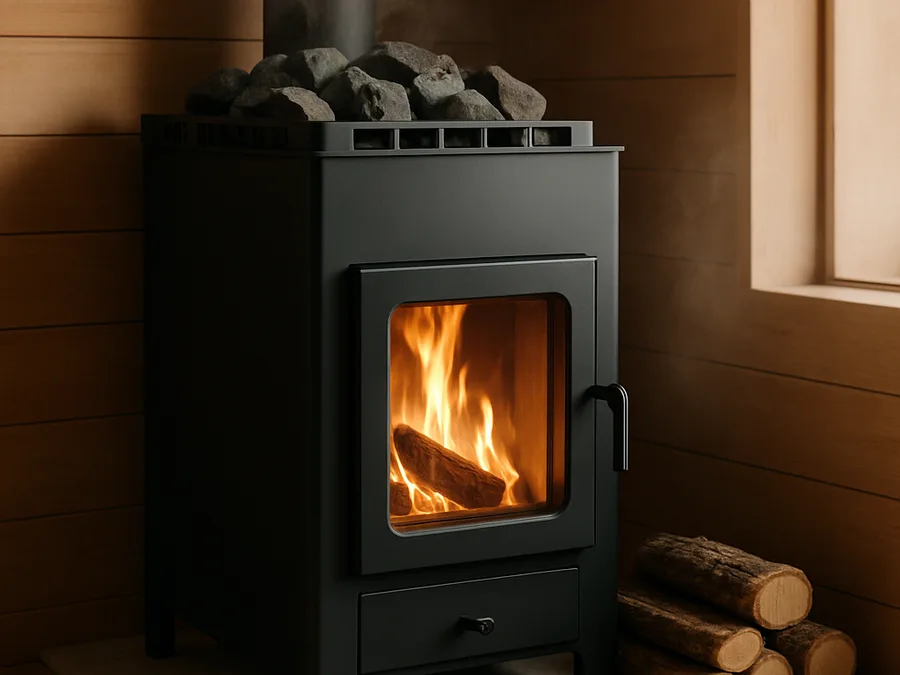
- Temp 150-195F+
- Heat-up 60-90 min
- Power None (firewood)
- Install Chimney + clearances
For outdoor, lakeside, or off-grid saunas, a wood stove gives the most authentic loyly and the crackle of a real fire with no electrical run at all. The trade-off is a code-compliant chimney with heat shielding and fire-rated clearances, a longer heat-up, and real ongoing maintenance.
Harvia, HUUM, and Kuuma make well-regarded wood stoves; Lamppa is a respected US maker. Match the stove's rated room volume to yours and budget for the chimney kit separately.
What works
- Most authentic, intense heat and steam
- No electrician or 240V circuit required
- Works fully off-grid
What to weigh
- Chimney, shielding, and clearances add cost
- Slowest heat-up; you tend the fire
- Most maintenance and a permit, usually
Skip if: the sauna is indoors or you want set-and-forget, push-button heat.
Circuit, wiring & controls
This is where a sauna heater becomes an electrical project. Plan it before you buy, and budget for a licensed electrician - it is the one part of a build that is genuinely dangerous to get wrong.
- Dedicated 240V circuit. Any rock heater above about 3 kW needs its own 240V circuit, sized to the heater: roughly 6 kW on a 30A breaker with #10 wire, 8-9 kW on 40A with #8. Always follow the heater's manual and your local code over any rule of thumb.
- GFCI protection. Sauna circuits should be GFCI-protected. Outdoor runs are often trenched in conduit, which pushes the install cost higher.
- Panel capacity. If your service has no spare capacity, a panel upgrade adds roughly $1,500-$3,000 - frequently the biggest single surprise in a sauna project.
- Controls. Heaters use either a built-in dial (simplest) or a separate digital controller mounted outside the hot zone, often with a timer and a delayed start. Place sensors and controllers per the manual, not wherever is convenient.
Stones, ventilation & clearances
- Use real sauna stones. Dense, non-porous igneous rock (peridotite, olivine diabase) sold for saunas - never landscaping or river stones, which can trap water and crack or explode. Use the weight the manual specifies, rinse them, and stack loosely so air and water flow through.
- Re-stack yearly. Stones settle and break down; restack them about once a year and replace crumbled ones so airflow and steam stay good.
- Ventilation. A traditional sauna needs an air inlet near the heater and an outlet on the far wall so fresh air moves through. Poor ventilation makes a sauna feel stuffy and stops it reaching temperature.
- Clearances. Respect the heater's required clearances to benches, walls, and the guard rail. These are safety minimums, not suggestions.
Common heater mistakes
- Undersizing. Trusting "seats 4" instead of sizing to cubic feet, so the room never gets properly hot.
- Ignoring glass and insulation. A glass door or uninsulated walls need a bigger heater than the bare volume suggests.
- Wrong stones. Using landscaping rock that cracks, or packing stones too tightly so steam and air cannot move.
- Bad ventilation. No inlet/outlet path, so the sauna feels stuffy and underperforms.
- DIY-ing the wiring. Guessing the breaker or wire gauge instead of using a licensed electrician.
The bottom line
For most indoor home saunas, a 6 kW electric rock heater on a dedicated 240V circuit is the right call. Larger or glass-fronted rooms want 8-9 kW. Building outdoors or off-grid? A wood-burning stove earns its extra maintenance with authentic heat. Whatever you choose, size it to your room's volume, use real stones, and get the 240V circuit quoted and installed by a licensed electrician. Building the room too? Start with the DIY sauna builds guide, and estimate the full cost before you buy.
Frequently asked questions
What size sauna heater do I need?
Electric or wood-burning sauna heater?
Does a sauna heater need a 240V circuit?
How many stones does a sauna heater need, and which kind?
Can I install a sauna heater myself?
How long does a sauna heater take to heat up?
Where should a sauna heater be placed?
How long does a sauna heater last?
How much does it cost to run a sauna heater?
How we wrote this
A synthesis guide, not a hands-on review
This guide synthesizes heater manufacturer specifications, sauna-builder references, and electrical and building-code guidance. Heater-sizing and circuit figures are general planning rules of thumb, not a substitute for the heater's own manual or a licensed electrician. We have not bench-tested every heater, so we recommend by type, size, and use-case rather than inventing star ratings, and we link to each maker so you can verify specs yourself. In the model comparison, output and price are planning ranges across each model's size variants, and the price links open an Amazon search for that model (an affiliate link, at no extra cost to you) - confirm the exact variant, kW, and current price on the listing before buying.
We have not personally tested every product mentioned. Where we describe a product we are synthesizing manufacturer specifications, independent expert reviews, building-code and electrical references, and verified owner feedback. Health information is kept conservative and sourced. Read our full methodology.
References
Sources synthesized to write this guide. Manufacturer pages cite specifications; independent publications, clinics, and code references cite real-world performance, safety, and evidence.
-
Volume math (L x W x H) and the ~1 kW per 45-50 cu ft heater-sizing rule used in the table below.
- [2] Haven of Heat - Sauna electrical requirements (240V vs 120V, breaker & wire gauge) accessed Jun 10, 2026
Breaker and wire-gauge sizing by heater kW, plus GFCI and dedicated-circuit requirements.
-
Cross-check on circuit sizing and why most home heaters need a dedicated 240V line.
-
Stone mass, heater placement, and how room build quality changes the kW you need.
-
Operating temperatures and the heat mechanism for traditional electric and wood heaters.
-
2026 price bands for residential electric and wood-burning sauna heaters.
Disclosure: Some links on this page are affiliate links. Commissions never change our recommendations. Read the full disclosure.