Last updated
Reviewed Jun 10, 2026Disclosure: Some links on this page are affiliate links - we may earn a commission at no extra cost to you. Commissions never change our recommendations. Read the full disclosure.
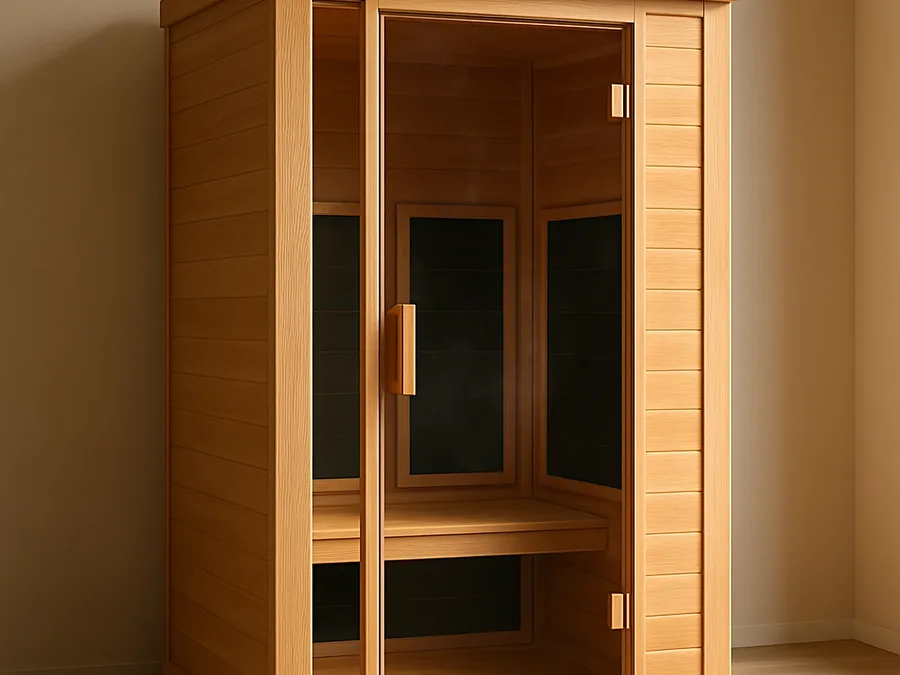
Infrared is the format most people actually stick with. It plugs into a normal outlet, heats up in 10-20 minutes, and runs cool enough (around 120-140F) that a 30-45 minute session feels easy rather than punishing. No 240V circuit, no electrician, no steam to manage. The trade-off is that it does not deliver the high-heat, steamy ritual of a traditional sauna - if that matters to you, read infrared vs traditional first.
Assuming infrared is your pick, the real decisions are size, panel type, EMF, and the fine print on power, warranty, and returns. Here is how to weigh each one - then a few honest recommendations by household rather than star-rated "winners."
1-person vs 2-person vs 4-person
Like every sauna, advertised capacity is optimistic - reduce it by a person if you want room to stretch. For most homes a 2-person cabin is the sweet spot: it fits a spare room or basement corner, plugs into a standard outlet, and gives one person space to lie back.
| Cabin size | Typical power | Space & use | Verdict |
|---|---|---|---|
| 1-person | ~300-600 W (1-2 panels) | Closet, corner, solo daily use | Smallest footprint |
| 2-person | ~1,200-1,800 W (3-4 panels) | Spare room, basement, couples | Best for most homes |
| 3-4 person | ~2,400-3,200 W (6-8 panels) | Larger rooms, sharing, lie-down space | May need a 20A or 240V circuit |
1-person
- Typical power
- ~300-600 W (1-2 panels)
- Space & use
- Closet, corner, solo daily use
- Verdict
- Smallest footprint
2-person
- Typical power
- ~1,200-1,800 W (3-4 panels)
- Space & use
- Spare room, basement, couples
- Verdict
- Best for most homes
3-4 person
- Typical power
- ~2,400-3,200 W (6-8 panels)
- Space & use
- Larger rooms, sharing, lie-down space
- Verdict
- May need a 20A or 240V circuit
Full-spectrum vs far infrared
Brands push full-spectrum hard, but most buyers are well served by quality far infrared. Here is the honest difference.
| Panel type | What it gives | Cost | Best for |
|---|---|---|---|
| Far infrared | Deep, comfortable warmth; what most people picture | Lower | Most buyers; daily relaxation & recovery |
| Full-spectrum | Adds near- and mid-infrared wavelengths | Higher | Buyers who specifically want near-infrared |
Far infrared
- What it gives
- Deep, comfortable warmth; what most people picture
- Cost
- Lower
- Best for
- Most buyers; daily relaxation & recovery
Full-spectrum
- What it gives
- Adds near- and mid-infrared wavelengths
- Cost
- Higher
- Best for
- Buyers who specifically want near-infrared
EMF, explained without the fear marketing
"Low EMF" is the most over-used phrase in infrared marketing. Here is what is actually true: cheap carbon-panel cabins can emit measurable low-frequency magnetic fields at the panel surface, and extremely-low-frequency magnetic fields are classified as a "possible" carcinogen on limited evidence. Reputable brands engineer panels that measure only a few milligauss where your body sits. This is worth understanding - not panicking about.
Power, warranty & placement checklist
- Power: most 1-2 person cabins use a standard 120V outlet; give it a dedicated circuit. Confirm the spec for 3-4 person cabins.
- Heat-up: 10-20 minutes is normal; faster is a nice-to-have, not essential.
- Warranty: look for multi-year coverage on heaters/panels and the cabin; read what is actually covered.
- Return policy: a real trial window matters - a sauna is hard to evaluate until you have used it for a few weeks.
- Placement: interior, level floor, near an outlet, with clearance to open the door fully. Not a damp garage or outdoors unless rated for it.
- Wood & build: hemlock and basswood are common; check for low-VOC glues and solid panel construction.
Best infrared saunas compared (2026)
Ten cabins buyers actually cross-shop, from budget far-infrared to premium full-spectrum. We have not lab-tested these, so this is a spec-and-reputation comparison, not a star-rated ranking - pick your size and panel type first, then weigh price against published EMF data, warranty, and return policy. Prices are planning ranges for the cabin only.
| Cabin | Capacity | Notable for | Approx. price | Where to buy |
|---|---|---|---|---|
| JNH Lifestyles Joyous | 2-person | Best value far-infrared cabin | $1,600-2,200 | Check price → |
| Dynamic Andora | 2-person | Popular mid-range far infrared in hemlock | $1,800-2,600 | Check price → |
| Maxxus Seattle | 3-person | Roomy far-infrared cabin for sharing | $2,400-3,200 | Check price → |
| LifePro Infrared Sauna | 1-2 person | Budget far infrared, frequent sales | $1,500-2,500 | Check price → |
| Durherm Far Infrared | 2-person | Carbon + ceramic far-infrared panels | $2,000-3,000 | Check price → |
| Sun Home Luminar | 2-person | Full-spectrum with published low-EMF data | $4,000-6,000 | Check price → |
| Clearlight Sanctuary | 1-2 person | Full-spectrum; strong warranty | $4,000-7,000 | Check price → |
| Sunlighten mPulse | 1-3 person | Programmable full-spectrum (premium) | $5,000-9,000 | Check price → |
| HigherDOSE Full Spectrum | 1-person | Full-spectrum with chromotherapy | $3,000-4,000 | Check price → |
| SaunaSpace Faraday | 1-person | Near-infrared incandescent; EMF-shielded | $3,000-5,500 | Check price → |
JNH Lifestyles Joyous
- Capacity
- 2-person
- Notable for
- Best value far-infrared cabin
- Approx. price
- $1,600-2,200
- Where to buy
- Check price →
Dynamic Andora
- Capacity
- 2-person
- Notable for
- Popular mid-range far infrared in hemlock
- Approx. price
- $1,800-2,600
- Where to buy
- Check price →
Maxxus Seattle
- Capacity
- 3-person
- Notable for
- Roomy far-infrared cabin for sharing
- Approx. price
- $2,400-3,200
- Where to buy
- Check price →
LifePro Infrared Sauna
- Capacity
- 1-2 person
- Notable for
- Budget far infrared, frequent sales
- Approx. price
- $1,500-2,500
- Where to buy
- Check price →
Durherm Far Infrared
- Capacity
- 2-person
- Notable for
- Carbon + ceramic far-infrared panels
- Approx. price
- $2,000-3,000
- Where to buy
- Check price →
Sun Home Luminar
- Capacity
- 2-person
- Notable for
- Full-spectrum with published low-EMF data
- Approx. price
- $4,000-6,000
- Where to buy
- Check price →
Clearlight Sanctuary
- Capacity
- 1-2 person
- Notable for
- Full-spectrum; strong warranty
- Approx. price
- $4,000-7,000
- Where to buy
- Check price →
Sunlighten mPulse
- Capacity
- 1-3 person
- Notable for
- Programmable full-spectrum (premium)
- Approx. price
- $5,000-9,000
- Where to buy
- Check price →
HigherDOSE Full Spectrum
- Capacity
- 1-person
- Notable for
- Full-spectrum with chromotherapy
- Approx. price
- $3,000-4,000
- Where to buy
- Check price →
SaunaSpace Faraday
- Capacity
- 1-person
- Notable for
- Near-infrared incandescent; EMF-shielded
- Approx. price
- $3,000-5,500
- Where to buy
- Check price →
Best infrared saunas by household
Treat these as size-and-use starting points. Where we mention brands - Sun Home, Clearlight, Sunlighten, and HigherDose are the names most often cross-shopped - compare their published EMF data, warranty, and return policy before buying.
Best for small spaces & solo use
1-person far-infrared cabin
- Power ~300-600 W
- Outlet Standard 120V
- Heat-up 10-15 min
- Temp ~120-140F
The easiest entry to a permanent cabin: a single-person far-infrared unit fits a closet-sized footprint or a corner, plugs into a normal outlet, and is ready in minutes. Ideal for one daily user in an apartment or small home.
Look for documented low-EMF panels and a sensible warranty; you do not need full-spectrum at this size unless you specifically want near-infrared.
What works
- Smallest footprint; fits almost anywhere
- Standard outlet, no electrician
- Lowest running cost of any cabin
What to weigh
- Tight - genuinely one person
- No lie-down space
- Far infrared only at this size, typically
Skip if: more than one person will use it at once - step up to a 2-person cabin.
Best infrared sauna for most homes
2-person far-infrared cabin
- Power ~1,200-1,800 W
- Outlet Standard 120V
- Heat-up 10-20 min
- Temp ~120-145F
The default recommendation. A 2-person cabin fits a spare room or basement corner, still runs on a standard outlet, and gives a solo user room to stretch out - the most flexible size for the money.
This is where brands like Sun Home, Clearlight, and Sunlighten compete hardest; compare published low-EMF data, warranty length, and return window rather than the headline price alone.
What works
- Fits most homes; room to recline solo
- Standard outlet, plug-and-play
- Widest model and price choice
What to weigh
- Needs a dedicated outlet ideally
- Optimistic '2-person' for two adults
- Full-spectrum versions cost noticeably more
Skip if: you only ever use it alone in a tiny space - a 1-person cabin saves room and money.
Best for sharing & lie-down space
3-4 person infrared cabin
- Power ~2,400-3,200 W
- Outlet 20A or 240V (check spec)
- Heat-up 15-25 min
- Temp ~120-150F
For households that want to share, or one person who wants to lie fully flat. The extra panel count raises power needs, so confirm whether the model needs a 20A circuit or even 240V before you buy.
Full-spectrum is more common at this tier; only pay for it if you specifically want near-infrared. Otherwise a large far-infrared cabin delivers the same comfortable heat for less.
What works
- Room to share or lie flat
- More panel coverage = even heat
- Full-spectrum options available
What to weigh
- Largest footprint; needs real floor space
- May require a dedicated 20A or 240V circuit
- Highest purchase and running cost
Skip if: space or budget is tight - a 2-person cabin suits most homes better.
The bottom line
For most homes, a 2-person far-infrared cabin with documented low-EMF panels is the best balance of space, comfort, and cost. Go smaller with a 1-person cabin for tight rooms, or larger with a 3-4 person cabin if you have the floor space and a suitable circuit. Want the high-heat, steamy alternative instead? Compare infrared vs traditional, or see all formats in the best home sauna guide. Curious what infrared actually does for you? Read the cited infrared sauna benefits guide.
Frequently asked questions
What is the best infrared sauna for home use?
Full-spectrum or far infrared - which do I need?
Do I need a special outlet for an infrared sauna?
Should I worry about EMF in an infrared sauna?
Do infrared saunas detox you or help you lose weight?
Can you put an infrared sauna in a bedroom?
How much does it cost to run an infrared sauna?
Can you wear clothes in an infrared sauna?
How long does an infrared sauna last?
How we wrote this
A synthesis guide, not a hands-on review
This guide synthesizes manufacturer specifications, independent infrared-sauna references, and EMF measurement guidance. We have not lab-tested individual cabins, so we recommend by size, panel type, and use-case rather than inventing star ratings, and we keep EMF and health claims conservative and cited. We flag detox and weight-loss marketing as unsupported rather than repeating it. In the model comparison, capacity and price are planning ranges, and the price links open an Amazon search for that model (an affiliate link, at no extra cost to you); premium brands that sell mainly direct will surface the closest Amazon listings, so always confirm panel type, EMF data, and warranty on the maker's own page before buying.
We have not personally tested every product mentioned. Where we describe a product we are synthesizing manufacturer specifications, independent expert reviews, building-code and electrical references, and verified owner feedback. Health information is kept conservative and sourced. Read our full methodology.
References
Sources synthesized to write this guide. Manufacturer pages cite specifications; independent publications, clinics, and code references cite real-world performance, safety, and evidence.
-
Cabin sizing, panel coverage, heat-up time, and warranty/return considerations.
-
Power draw, plug-in install, and full-spectrum vs far-infrared positioning.
-
Operating temperatures and how radiant infrared heat differs from a rock heater.
- [4] International Agency for Research on Cancer - ELF magnetic fields (Group 2B) accessed Jun 10, 2026
Classification context for the EMF discussion - 'possibly carcinogenic' on limited evidence.
-
Clinic summary of benefits and who should avoid sauna use.
Disclosure: Some links on this page are affiliate links. Commissions never change our recommendations. Read the full disclosure.