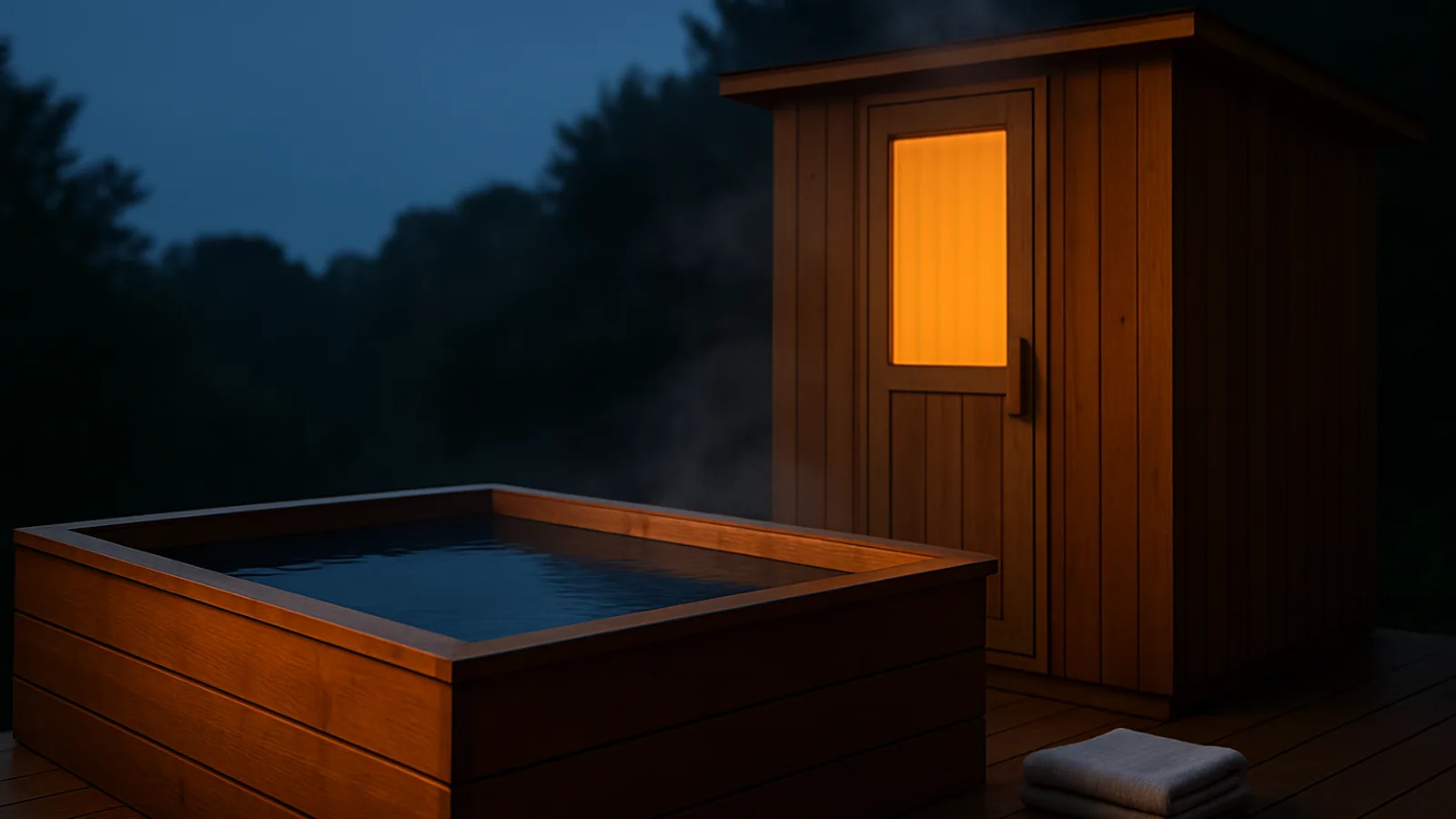
"Cold plunge vs sauna" frames the two as competitors, but they are closer to opposites that happen to pair well. A sauna heats you; a cold plunge chills you. Each stresses your body in a different direction, and your body adapts to both. So the real questions are: which has the better evidence, which fits your goal, and should you actually be choosing at all?
The honest headline
If you want the habit with the strongest evidence, it is the sauna. Large, long-term observational studies - led by Laukkanen et al. (2015) - link frequent traditional sauna use with lower cardiovascular and all-cause mortality. Cold plunging's evidence is younger and thinner: a 2025 review found modest, time-dependent benefits for sleep, recovery, and stress, but little support for the mood and immunity claims. Neither is a cure-all, and both have caveats - but on weight of evidence, the sauna leads.
Side by side
| Sauna | Cold plunge | |
|---|---|---|
| What it is | Dry or steamy heat, ~45-90°C (110-195°F) | Cold-water immersion, ~10-15°C (50-59°F) to start |
| Main effect on the body | Blood vessels dilate; heart rate rises like light exercise | Cold-shock response; vessels constrict; blood pressure spikes |
| Strength of evidence | Strongest - large long-term observational studies | Early - few small, mostly short-term trials |
| Best supported for | Cardiovascular health, relaxation, longevity signal | Sleep, recovery/soreness, possibly stress resilience |
| Overclaimed for | Detox, weight loss (ignore these) | Instant mood boost, immunity, fat loss (unproven) |
| Who should be cautious | Pregnancy, heart conditions, unstable blood pressure | Heart/rhythm/circulation conditions, diabetes, pregnancy |
| Cheapest way to start | Portable infrared or a hot shower | A cold shower - no tub required |
What it is
- Sauna
- Dry or steamy heat, ~45-90°C (110-195°F)
- Cold plunge
- Cold-water immersion, ~10-15°C (50-59°F) to start
Main effect on the body
- Sauna
- Blood vessels dilate; heart rate rises like light exercise
- Cold plunge
- Cold-shock response; vessels constrict; blood pressure spikes
Strength of evidence
- Sauna
- Strongest - large long-term observational studies
- Cold plunge
- Early - few small, mostly short-term trials
Best supported for
- Sauna
- Cardiovascular health, relaxation, longevity signal
- Cold plunge
- Sleep, recovery/soreness, possibly stress resilience
Overclaimed for
- Sauna
- Detox, weight loss (ignore these)
- Cold plunge
- Instant mood boost, immunity, fat loss (unproven)
Who should be cautious
- Sauna
- Pregnancy, heart conditions, unstable blood pressure
- Cold plunge
- Heart/rhythm/circulation conditions, diabetes, pregnancy
Cheapest way to start
- Sauna
- Portable infrared or a hot shower
- Cold plunge
- A cold shower - no tub required
What each is best at
Reach for the sauna if your priority is long-term cardiovascular health, relaxation and winding down, or recovery after strength training (heat does not appear to blunt muscle growth). It is also the gentler on-ramp for most beginners. See sauna benefits for the evidence in full.
Reach for the cold plunge if you want a sharp alertness reset, help with next-day soreness on non-lifting days, or you simply enjoy the post-cold clarity and find it helps your sleep. Just respect the safety rules in how to cold plunge - the first minute is where the real risk lives.
If you can only do one
For most people most of the time, choose the sauna: it has the stronger evidence, it is easier to do consistently, and it is more forgiving if you have minor health considerations (though pregnancy and heart conditions still warrant a doctor's input). Pick the cold plunge only as your single tool if your specific goal is acute recovery or you genuinely prefer cold - and only after clearing it with a clinician if you have any heart, rhythm, or circulation condition.
A word on safety either way
Both are real physiological stressors. Saunas mainly tax you through heat and fluid loss; cold plunges add the cold-shock response that the Cleveland Clinic and Harvard Health flag as risky for anyone with heart-rhythm or circulation problems. If you have a heart condition, high or unstable blood pressure, diabetes, or are pregnant, talk to a doctor before starting either - and be especially careful with cold.
The bottom line
A sauna and a cold plunge are not rivals so much as two halves of a recovery routine. If you only have the appetite (or budget) for one, start with the sauna and its stronger evidence - the best home sauna guide will help you pick a format. When you are ready to add cold, the how-to and contrast therapy guides take it from there.
Frequently asked questions
Is a sauna or cold plunge better for you?
Should I do a cold plunge or sauna for muscle recovery?
Can you do a sauna and cold plunge together?
Which is safer, a sauna or a cold plunge?
Sources
- Laukkanen et al., 2015, JAMA Internal Medicine - Sauna bathing and cardiovascular and all-cause mortality
- Cain et al., 2025, PLOS One - Effects of cold-water immersion on health and wellbeing
- Harvard Health - Cold plunges: healthy or harmful for your heart?
- Cleveland Clinic - What to know about cold plunges
Last updated
This is general educational information, not medical advice. Neither heat nor cold immersion is safe for everyone; check with a doctor before starting if you have a heart, blood-pressure, rhythm, or circulation condition, diabetes, or are pregnant.