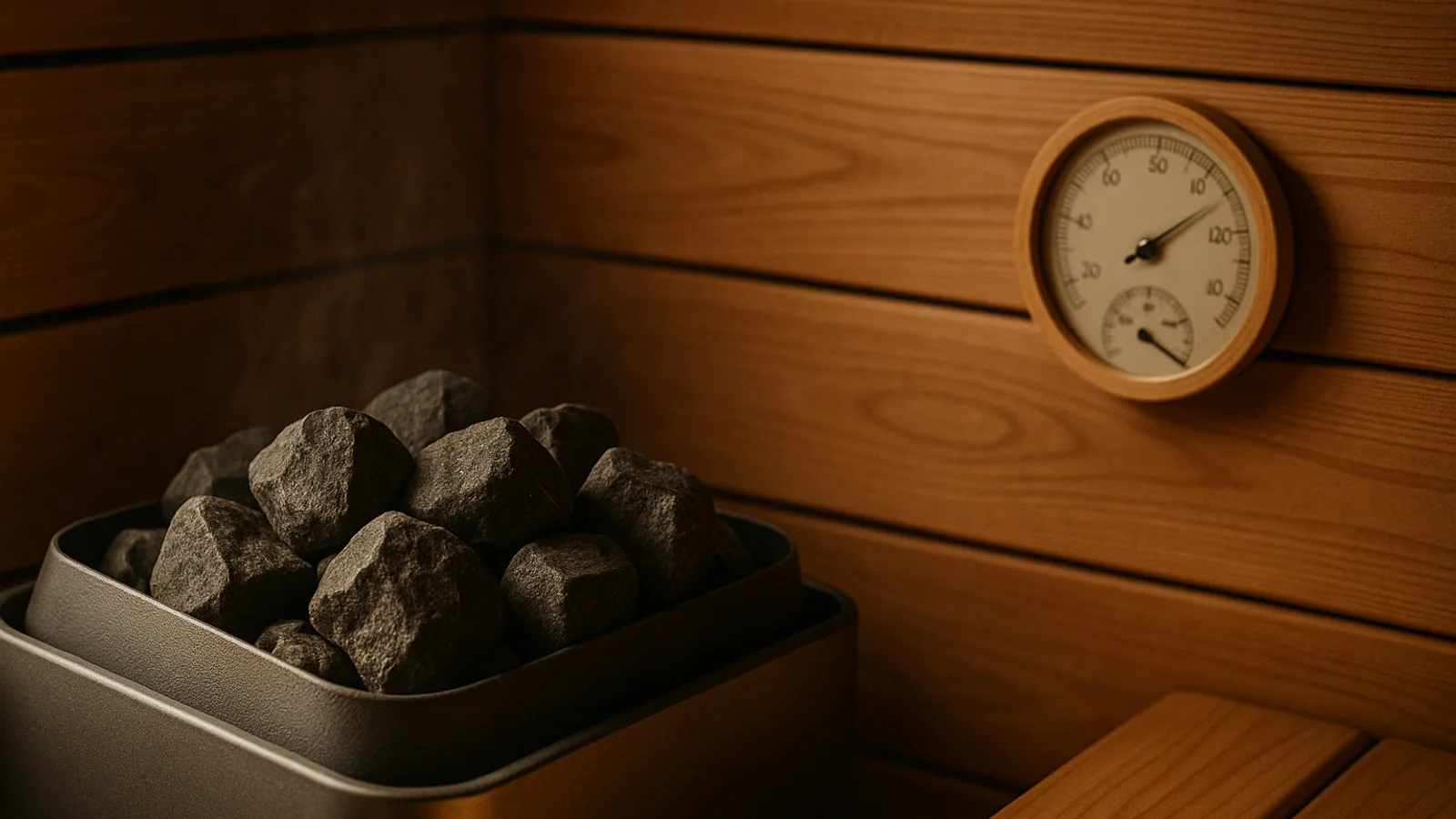
Two things decide how a sauna feels: the air temperature and the humidity. A dry 90C and a steamy 70C can feel similarly intense. Knowing the typical ranges helps you set yours - or pick a type - for the experience you want.
Typical temperature ranges
- Traditional Finnish sauna: about 70-90C (150-195F) at head height, sometimes hotter. This is the high-heat, steam-capable classic.
- Infrared sauna: about 45-60C (110-150F). It feels gentler in the air but still makes you sweat because the heat reaches your body directly.
Harvard Health describes a typical Finnish sauna around 175F (about 80C) with sessions of roughly 15-20 minutes. Start cooler and lower if you are new, and build up.
Hotter is not better for everyone. If you are pregnant, have heart disease, low or high blood pressure, or are new to heat, favour the lower end of these ranges and keep sessions short - and check with a doctor first. See our sauna safety guide for who should be cautious and sensible limits.
How humidity changes everything
In a traditional sauna, the base humidity is low and dry. When you ladle water onto the hot stones, you create loyly - a burst of steam that briefly raises humidity to anywhere from roughly 10% to 60%. Moist air carries heat to your skin far more efficiently than dry air, so the room feels much hotter even though the thermometer hardly changes. That is why two people can sit in the "same" sauna and experience very different intensities depending on how much water goes on the rocks.
Infrared saunas have no stones and no steam - they are dry by design. They rely on radiant heat rather than humidity, which is why they can run at a much lower air temperature and still produce a sweat. If steam and the splash-of-water ritual matter to you, you want a traditional sauna; see our home sauna comparison for the full trade-off.
Where you sit matters
Heat stratifies - the air near the ceiling is significantly hotter than near the floor. On a tiered bench, the top bench can be 10-20C hotter than the bottom. If a sauna feels too intense, simply move down a bench rather than cutting the session short.
Setting your own sauna
If you are building or buying, size the heater to the room so it can comfortably reach temperature - a rough rule is about 1 kW of heater per 1.3 cubic metres (roughly 45-50 cubic feet) of well-insulated room, with more for glass or poor insulation. Our DIY build guide walks through heater sizing, and the cost calculator turns a size into a budget.
Frequently asked questions
How hot should a traditional sauna be?
Why does an infrared sauna feel hot at a lower temperature?
Does adding water make a sauna hotter?
Sources
Last updated
Health information here is general and educational, kept conservative and cited - not medical advice. Check with a doctor before starting sauna use if you have a health condition.